
The Spring Reset: Lymphatic Drainage, Gut Health & Sustainable Nutrition.
The Spring Reset: Lymphatic Drainage, Gut Health & Sustainable Nutrition. Home / Blog As a
Massage Therapy In Marylebone, London By Marta
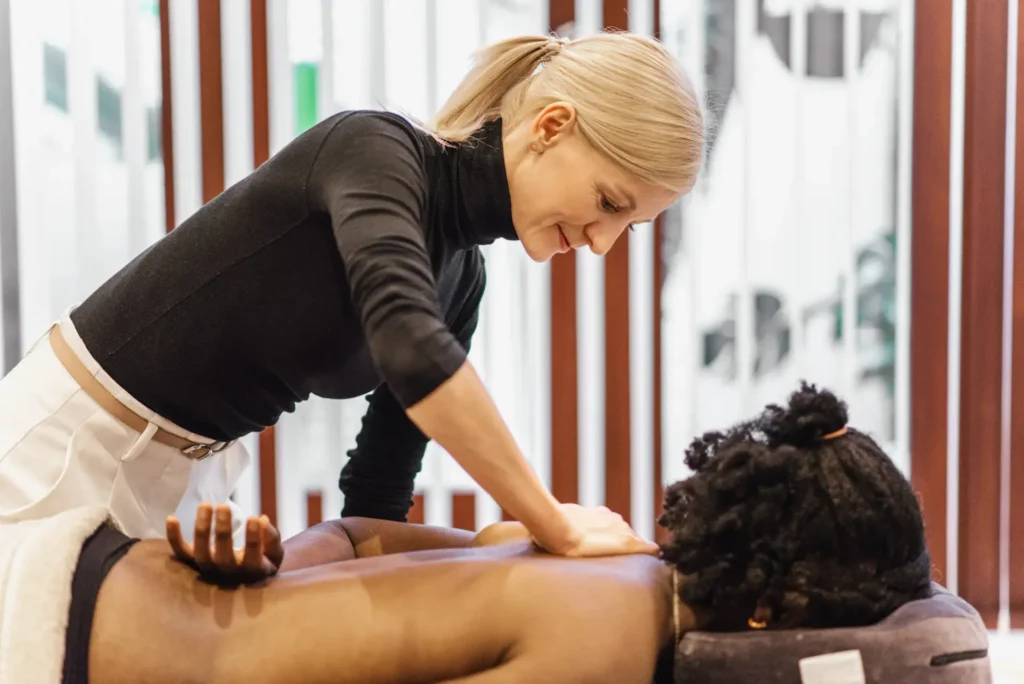
If you live with ongoing muscle tightness, “mysterious” aches or tension that never quite goes away, you may have heard of myofascial therapy. This hands-on treatment works on your fascia – the web of connective tissue around your muscles – to release restrictions, ease pain and restore easier movement. In this guide, we’ll explain what myofascial therapy is, how it works, who it can help and what to expect when you book a session in London
If you are comparing sports massage vs myofascial release in London, you are probably trying to answer one very practical question: which treatment is more likely to help your body feel and move better? You may be dealing with post-training tightness, recurring shoulder or lower back tension, restricted mobility, or pain that keeps returning no matter how much you stretch.
The difference matters because these two approaches are not identical. Sports massage is usually more dynamic and muscle-focused, often used around activity, recovery, performance, and overuse. Myofascial release is slower, more targeted to fascia and trigger points, and often chosen when pain feels persistent, movement feels “stuck”, or tension patterns seem deeper and harder to shift. At MassageTherapy.London, Myofascial Release Therapy is one of the clinic’s current core services, alongside Deep Tissue – Remedial Massage and Signature Massage.
It is also worth being realistic. Massage and hands-on therapy can be helpful, but they are not magic fixes. The real question is not “which one is stronger?” but “which one is more appropriate for what your body is doing right now?”

Sports massage is a targeted, goal-led treatment designed for muscles and other soft tissues affected by training, repetitive movement, overuse, posture, or physical load. It is not only for elite athletes. In practice, it can also suit gym-goers, runners, cyclists, active professionals, and desk workers whose bodies feel tight, overloaded, or out of balance. Sessions often combine firm massage, trigger point work, assisted stretching, and mobility-focused techniques depending on what the body needs that day.
That goal-led nature is what makes sports massage appealing. If your calves feel heavy after running, your shoulders are tight after strength training, or your hips feel stiff after a mix of exercise and long hours sitting, sports massage is usually aimed at helping those specific tissues recover and function better.
Myofascial release therapy focuses on the fascia: the connective tissue network that surrounds and supports muscles and other structures throughout the body. Rather than using mainly rhythmic strokes, myofascial work applies gentle, sustained pressure and stretching to areas of restriction so tissue can soften, lengthen, and move more freely.
This distinction becomes especially useful when symptoms are not just “sore muscles”. Some pain patterns are more complex than simple post-exercise muscle tightness, and a fascia- and trigger-point-oriented treatment may make more sense in those cases.
Sports massage tends to focus more on muscles, load, recovery, and movement demands. It is often chosen when the issue is linked to training, repetitive activity, or muscular fatigue.
Myofascial release tends to focus more on fascial restriction, trigger points, long-held tension, and movement limitation. It is often chosen when discomfort feels diffuse, recurring, or structurally “stuck”.
Sports massage is usually more dynamic. It may include kneading, compression, deep tissue pressure, stretching, and more localised work around overused muscle groups.
Myofascial release is slower and more sustained. Instead of lots of movement, the therapist may stay in one area longer, waiting for a gradual release in the tissue.
Sports massage often feels more obviously “worked”. You may feel pressure, tenderness, or a deeper muscular intensity during trigger point or recovery work.
Myofascial release often feels quieter, slower, and more subtle at first, although it can still feel intense in restricted areas. The intensity is less about force and more about staying with the tissue long enough for it to change.
A simple way to think about it is this:
Sports massage usually makes more sense when your main complaint is linked to activity and muscular load.
For example, it may suit you if:
This is also why sports massage has traditionally been popular with runners, lifters, cyclists, and people who train regularly. The focus is often less on broad structural patterning and more on helping specific tissues recover, calm down, and function better around your training demands.
Myofascial release is often the stronger option when the issue feels older, broader, more recurrent, or harder to localise.
It may be more appropriate if:
That does not mean myofascial release is automatically “better”. It means it may be the more logical choice when the tissue problem looks more like restriction and patterning than straightforward muscular fatigue.
Yes — and in real clinical practice, they often are.
Many therapists blend myofascial work with deep tissue, remedial massage, and sports massage techniques in the same treatment plan. That is often the most sensible answer for active people. Sometimes you need muscle-focused recovery work. Sometimes you need slower fascial release. Sometimes the best session blends both, depending on whether the main issue is fatigue, restriction, pain, posture, or a combination of all four.
Whether you choose a more sports-oriented treatment or myofascial therapy, a good appointment should begin with a short consultation. The therapist should ask what you are feeling, what activities you do, how long the issue has been present, what makes it worse, and what outcome you want from the session. From there, treatment is shaped around the pattern, not just the sore spot.
In a sports-focused session, treatment may be more direct and muscular. In a myofascial session, the therapist may spend longer on fewer areas, following the tension pattern through related regions rather than chasing symptoms only where they hurt. Aftercare often includes hydration, gentle movement, and paying attention to how the body responds over the next 24 to 48 hours.
A useful rule is that treatment should feel purposeful, not unbearable.
Sports massage can feel tender, especially around overworked tissue or trigger points. Myofascial release usually feels slower and less forceful, but restricted areas can still feel intense. In either case, good communication matters. Pressure should be adjusted to your tolerance and to how the tissue is responding, not pushed for the sake of it.
Neither sports massage nor myofascial release is a replacement for medical diagnosis.
If you have new, severe, or unexplained pain, major swelling, a suspected tear, fever, signs of infection, recent fracture, clotting concerns, significant neurological symptoms, or a complex medical history, it is better to speak with your GP or specialist first.
Choose sports massage-style bodywork when the problem is mainly about training load, muscle fatigue, recovery, or short-term readiness.
Choose myofascial release when the problem feels more like chronic tension, recurring pain, restricted mobility, trigger point patterns, or posture-related pulling.
And if you are not sure, that uncertainty is often the clue that you need an assessment-led treatment rather than choosing purely by name. The best therapist will work backwards from your symptoms and goals, not force you into a single label.
No. Sports massage can also be useful for gym-goers, active people, runners, cyclists, and desk workers with muscular tension linked to overload, posture, or repetitive movement.
Not automatically. Myofascial release may be more suitable for chronic pain, trigger points, restricted movement, or recurring tension patterns, while sports massage may be more suitable for muscle recovery and activity-related tightness.
It often forms part of treatment for postural tension affecting the chest, neck, shoulders, jaw, and lower back, especially where symptoms are persistent and movement feels limited.
That is exactly where myofascial therapy can be worth considering. It can be particularly useful when tension is ongoing, restrictions keep returning, or the body feels “stuck” rather than simply tired.
When comparing sports massage vs myofascial release, the best choice is not about which treatment sounds tougher. It is about matching the treatment to the pattern.
If your body is dealing with recent overload, muscle soreness, or recovery needs, sports-focused bodywork may be enough. If your pain is recurrent, your movement feels restricted, or tension seems to run deeper than the muscles alone, Myofascial Release Therapy is often the smarter starting point.
If you are looking for a more precise, assessment-led approach in Marylebone, book Myofascial Release Therapy. And if you want a broader session that blends recovery, deeper tissue work, and individual adaptation, Signature Massage or Deep Tissue – Remedial Massage may be the better fit.

Marta Suchanska is the founder of MɅSSɅGE, a Certified Massage Therapist, Nutritional Therapist, and final-year student of Osteopathic Medicine based in Marylebone, London. With over 10 years of experience, she specialises in a holistic, personalised approach to women’s health and chronic pain. Marta’s mission is to address root causes, helping clients restore balance and long-term wellbeing.
Book Your Massage in Marylebone
Ready to experience the benefits of regular massage?
Book your personalised session at our Marylebone clinic today.
Call us or use our online booking system to schedule your appointment and start your wellness journey.
The Spring Reset: Lymphatic Drainage, Gut Health & Sustainable Nutrition. Home / Blog As a
Deep Tissue Massage London vs Myofascial Release London: An Expert Guide Home / Blog If